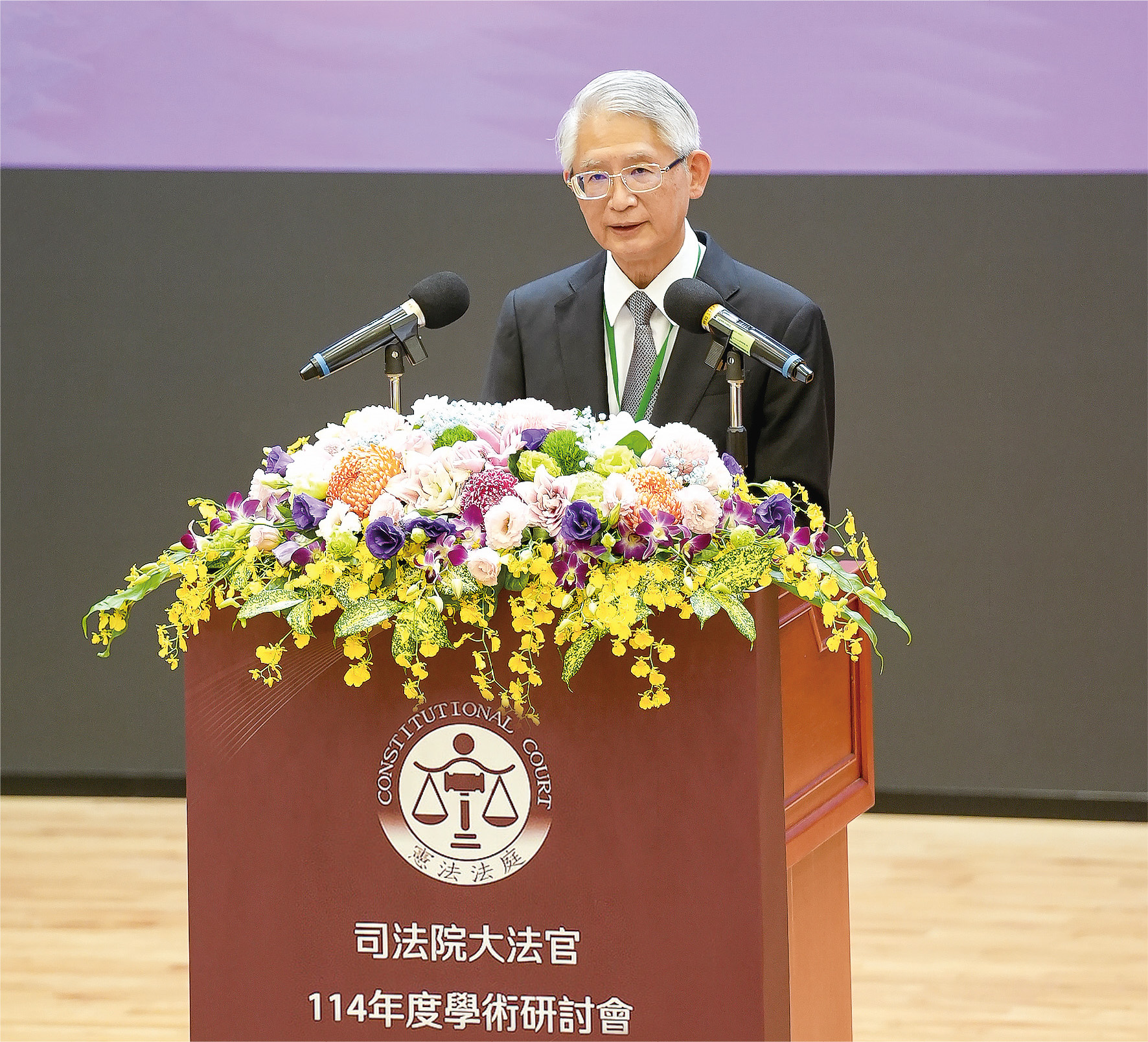
 Photo Description: Acting President and Chief Justice Dr. Ming-Yan SHIEH commencing the TCC Annual Academic Conference 2025.
On December 5, 2025, the Justices of the Taiwan Constitutional Court (TCC) held the TCC Annual Academic Conference of 2025 under the theme of “Methods of Constitutional Interpretation [解釋憲法之方法].” The Annual Academic Conference, a long-standing yearly tradition of the TCC, aims to facilitate dialogue and the exchange of opinions among practitioners and academics of constitutional justice.
Acting President of the Judicial Yuan and Chief Justice of the TCC (ex officio), Dr. Ming-Yan SHIEH, opened the event by introducing the conference theme. He recounted the major decisions TCC has made and how constitutional reviews have advanced fundamental rights and strengthened the checks and balances since the implementation of the Constitutional Court Procedure Act in 2022. Chief Justice SHIEH emphasized that, amid rapid technological development and a highly diversified society, the importance of constitutional interpretation is increasingly prominent. The more objective, transparent, and meticulous the method of interpretation is, the greater society’s confidence in the constitutional decisions will be. This year’s conference was organized by Justice Po-Hsiang YU. With the theme “Methods of Constitutional Interpretation,” Justice YU looked forward to exchanging ideas that better clarify constitutional arguments and provide further insights to strengthen the constitutional order.
The conference consists of one keynote speech and three panel sessions, illustrating different constitutional interpretation methods and their theoretical foundation:
The keynote speech (first session), “The Two Worlds of Constitutional Interpretation [法律解釋的兩個世界],” was presented by former President of the Judicial Yuan and Chief Justice (emeritus) of the TCC, Dr. In-Jaw LAI. Starting from the Nix v. Hedden case (149 U.S. 304) and Church of Holy Trinity v. United States (143 U.S. 457), former President LAI illustrated two long-standing methods of constitutional interpretation in the Supreme Court of the United States: pragmatism and textualism. From the vantage point of the two methods’ approaches to common law and statutory law, he noted that the two methods may also be observed in the Supreme Court’s Grand Court rulings. He concluded his speech by emphasizing that constitutional interpretation shall be constrained by constitutional texts and that the judiciary shall avoid law-making by considering the extent of textual meanings when interpreting laws.
The second session, “The Functions and Limits of Social Science in Constitutional Interpretation [社會科學在憲法解釋中的功能與侷限],” was presented by Professor Chia-Yin CHANG (Soochow University School of Law). Drawing on the debate over whether to consider legislative facts in constitutional review, Professor CHANG argued that constitutional decisions should take into account the constitutional order’s social settings and implications. He noted that the two models (Sozialmodell [social model] and Folgenorientierung [result-oriented]) may serve as ways of incorporating interdisciplinary studies, i.e., social science, into constitutional interpretation. However, as social science works fundamentally differently from the legal system, Professor CHANG also reminded that constitutional jurisprudence should develop a mode of dialogue rather than being led by social science. His presentation was joined by discussant Professor Ming-Shiou CHERNG (Soochow University School of Law). Justice Tsai-Chen TSAI chaired this session.
The third session, “Republicanism and Textualist Originalism: The Political Theoretical Dimensions of Constitutional Interpretation [共和主義與文本原意主義:論憲法解釋的政治理論向度],” was presented by Professor Chueh-An YEN (College of Law, National Taiwan University). Drawing on the concept of freedom from domination in republicanism philosophy, Professor YEN noted that public power should operate on justifiable and verifiable grounds, and that de facto dominance should be avoided through institutional design. He also stated, from a textualist-originalist perspective, that the textual meaning of the constitutional provisions and the original intent at the time of their enactment remain a crucial starting points and constraints for interpretation. Professor YEN also touched on recent issues, such as the exercise of legislative powers and judicial independence. He illustrated the need for a clear understanding of the political-theoretical position underpinning constitutional interpretation when addressing disputes over the distribution of power. His presentation was joined by discussant Academician Carl K. Y. Shaw (Research Center for Humanities and Social Sciences, Academia Sinica). Justice Fu-Meei JU chaired this session.
The fourth session, “ The Application of Taiwan’s Legal History in Constitutional Litigation [台灣法律史在憲法訴訟上的運用],” was presented by Professor Tay-Sheng WANG (College of Law, National Taiwan University). Professor WANG emphasized that studies of Taiwan’s legal history encompass not only the evolution of statutes but also the factors and socio-political context shaping the formation of institutions across different periods, as well as people’s actual experiences interacting with the law. With reference to constitutional cases on transitional justice, the evolution of property rights, and indigenous rights, Professor WANG noted that legal history may help pinpoint the facts concerning the challenged provisions’ legislative background, the challenged decisions’ application of law, and the case itself. Professor WANG concluded that, as the study of legal history can provide factual evidence for the process of legal syllogism, its application in constitutional litigation can reinforce the reasoning of the decision and urge the citizens to pursue social justice in accordance with the necessities of the time. His presentation was joined by former TCC Justice Horng-Shya HUANG. Justice Chung-Wu CHEN chaired this session.
Conference participants engaged productively in the panel sessions, maintaining the conference tradition of facilitating dialogue between law practitioners and academics in constitutional justice and related fields.
Justice Tai-Lang LU concluded the conference by pointing out that the truth of history is often constructed through the lens of its interpreters, and the substance of the Constitution is likewise shaped by the hands of those who interpret it. He emphasized that mastering the methods of constitutional interpretation is crucial to understanding the forms the Constitution can take. Justice LU encouraged the participants to continue applying the insights cultivated today and to become a guiding force in the development of constitutionalism and the protection of fundamental rights in their respective posts.