Two Speeches by the Delegation of the Constitutional Court of Belgium: “Justice constitutionnelle et paix” by President Pierre Nihoul and “Cour constitutionnelle, questions éthiques, autodétermination et égalité des genres (notamment au-delà de la dichotomie homme-femme)” by Judges Joséphine Rebecca Moerman and Emmanuelle Bribosia (November 18, 2025)
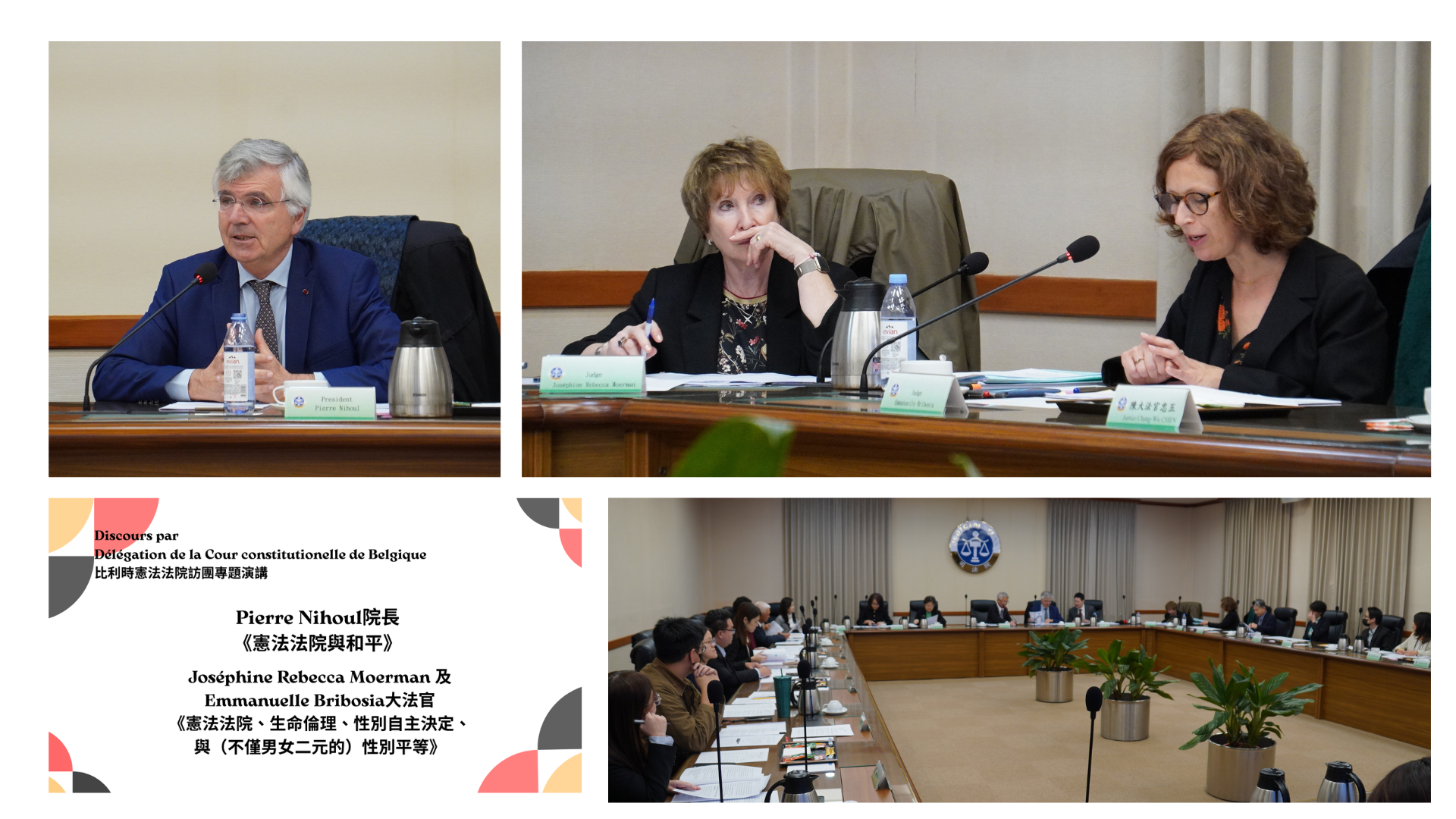
On November 18, 2025, the Judicial Yuan and the Taiwan Constitutional Court (TCC) welcomed the speeches by President Pierre Nihoul of the Constitutional Court of Belgium on “Justice constitutionnelle et paix [Constitutional justice and peace]” and by Judges Joséphine Rebecca Moerman and Emmanuelle Bribosia on “Cour constitutionnelle, questions éthiques, autodétermination et égalité des genres (notamment au-delà de la dichotomie homme-femme) [Constitutional court, ethical issues, self-determination and gender equality (especially beyond the male-female dichotomy)]” (both translated into Traditional Chinese by Associate Research Professor Tzung-Mou WU).
President Nihoul started his speech “Justice constitutionnelle et paix” by pointing out that although the Belgian Constitution makes no specific reference to peace or reconciliation, the Belgian Constitutional Court plays a vital role in maintaining internal peace, which has long been threatened along three traditional divisions, namely: language, ideology and religion, and socio-economic divisions. Following the federalization of the state, conflicts between linguistic groups have mainly been pacified through assigning powers and granting legislative competence to each federated component. It is essentially the Constitutional Court’s responsibility to ensure peace between the communities in accordance with the principle of federal loyalty, which is interpreted as requiring compliance with the principle of proportionality. The ideological-religious divide in Belgium was largely pacified by the adoption of the Cultural Pact, later enshrined in constitutional guarantees of non-discrimination and federal legislative obligation to prevent any form of discrimination, on which the Constitutional Court developed its relevant case laws. In terms of the socio-economic division, social peace in the sense of good relations between employers and employees regularly features in the case law of the Belgian Constitutional Court as a legitimate objective for assessing differential treatment or interference with fundamental rights. As new divisions arise around contemporary issues such as environmental and climate challenges, a new constitutional duty of “intergenerational peace” requires the federal government and the communities and regions to pursue the objective of “sustainable development in its social, economic, and environmental aspects, taking into account solidarity between generations.” By protecting human rights, democracy, and the rule of law through its case laws, the Belgian Constitutional Court has certainly contributed to social peace.
In their speech “Cour constitutionnelle, questions éthiques, autodétermination et égalité des genres (notamment au-delà de la dichotomie homme-femme),” Judges Moerman and Bribosia started by outlining the jurisprudence of gender equality in Belgian constitutional law and the Court’s case law. The principle of equality and non-discrimination has been central to the Belgian Constitution’s protection of fundamental rights since its inception. The explicit addition of gender equality in the Constitution in 2022 has provided a constitutional basis for positive action measures such as mandatory gender diversity on electoral candidate lists. However, the Judges noted that the Belgian Constitutional Court has consistently rejected arguments that seek to infer a binary conception of sex and gender from the Constitution’s emphasis of equality between women and men. With reference to the Court’s judgment no.99/2019, the Judges noted that such emphasis does not prevent measures from being taken to combat differential treatment based on non-binary gender identities. Drawing directly on European and international case law, the Belgian Constitutional Court considers that differential treatment based on sex has a suspicious nature, which should lead to increased scrutiny in its reviews. The Judges further examine in greater depth and context the Constitutional Court’s case laws on non-binary gender self-determination (with a focus on changing the sex record on birth certificate), voluntary termination of pregnancy, and euthanasia, all of which presented a delicate balancing of the fundamental rights involved and demonstrated rich dialogue with comparative case laws and legislations.
Following the speech, the delegation and Justices of the TCC (including Justice Hui-Chin YANG, who joined during the speech) engaged in friendly dialogue, exchanging further opinions on case law and international decisions concerning indirect discrimination, gender disparity caused by civil service recruitment criteria, in vitro fertilization (IVF), and LGBTQ rights. They also exchanged views on the vacancies in the constitutional court during the rotation of justices (judges) and on the legislative-judicial relationship in their respective countries.
Chief Justice SHIEH closed the session by thanking the delegation for sharing their Court’s experience in safeguarding social peace, promoting gender equality, and deciding on bioethics cases. He emphasized that, as partners in safeguarding the rule of law, the TCC and the Constitutional Court of Belgium face similar constitutional issues. He concluded that this exchange provided valuable insights into comparative constitutional review methods and further expressed his hope to strengthen future bilateral cooperation in upholding the values of constitutional democracy, the rule of law, and human rights.