The Judicial Yuan and the Taiwan Constitutional Court Sincerely Welcome the Visit of Prof. Richard H. Pildes (New York University School of Law)
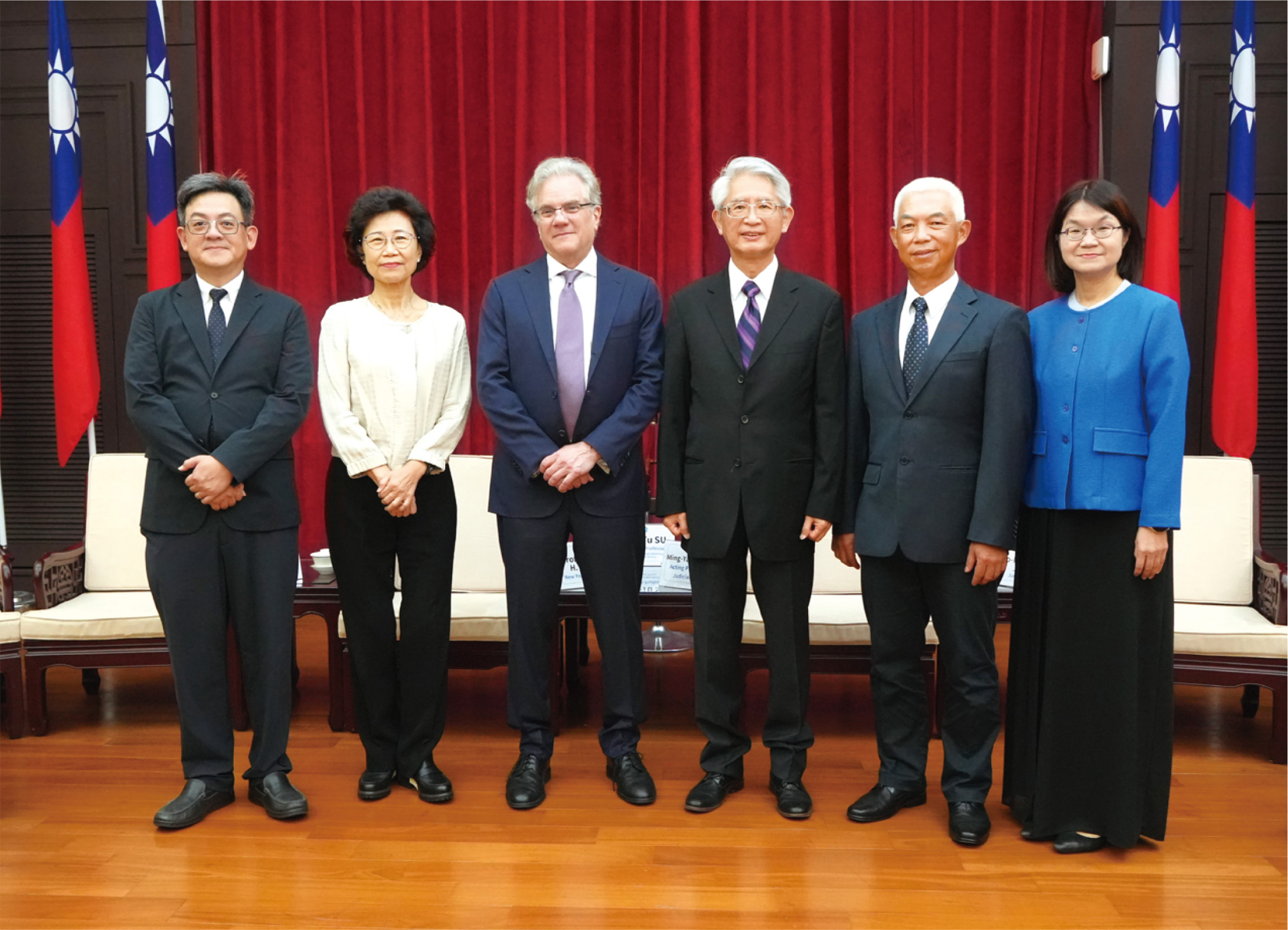 Photo description: The visit of Prof. Richard H. Pildes (New York University School of Law).
From left to right: Research Professor Yen-Tu SU, Justice Fu-Meei JU, Prof. Richard H. Pildes, Acting President & Chief Justice Ming-Yan SHIEH, Justice Po-Hsiang YU, and Director-General Bih-Huey HSU.
On August 10, 2026, the Judicial Yuan and the Taiwan Constitutional Court (TCC) welcomed Professor Richard H. Pildes, Sudler Family Professor of Constitutional Law at New York University School of Law, on his visit. He was accompanied by Research Professor Yen-Tu SU of the Institutum Iurisprudentiae, Academia Sinica. On behalf of the Judicial Yuan and the TCC, the Acting President of the Judicial Yuan and Chief Justice Ming-Yan SHIEH extended a warm welcome to Prof. Pildes upon their meeting. The meeting was also attended by Justice Fu-Meei JU, Justice Po-Hsiang YU, and Director-General Bih-Huey HSU of the TCC.
During his visit, Prof. Pildes delivered a speech titled “Political Polarization and Constitutional Courts: An American Perspective,” with consecutive interpreting provided by Research Professor SU. Prof. Pildes’s speech focused on the relationship between the political branches and constitutional courts, and the permissible forms of control or intervention that political branches can exercise over constitutional courts without compromising the rule of law and judicial independence. Drawing on reform proposals examined by the Presidential Commission on the Supreme Court of the United States, Prof. Pildes discussed the viability and potential risks of court-packing, ending life tenure, introducing supermajority voting requirements, and limiting the Court’s jurisdiction. Prof. Pildes emphasized that the proper role of courts in a constitutional democracy has always been, and always will be, a contested and debated question. He noted that there are at least two ways in which legislatures can abuse their power over the judiciary: (1) by significantly weakening the courts’ ability to function in the constitutional system; and (2) by seeking to entrench themselves in office more deeply and weakening the processes of fair democratic competition. Prof. Pildes concluded his speech by outlining three constraints on legislative abuse of power: (1) political culture; (2) the judicial self-restraint and constitutional courts’ understanding of their institutional roles; and (3) constitutional courts' recognition and enforcement of limits on the power of the political branches to undermine the rule of law.
After his speech, the Justices of the TCC and other Judicial Yuan officials engaged in in-depth discussion with Prof. Pildes. Their exchanges focused on the application of the political question doctrine, ways to build mutual trust in the judicial confirmation process, and the quorum requirements at the U.S. Supreme Court.